BIODIVERSITY IN THE SOUTH CAUCASUS

In collaboration with the National Geographic Magazine-Georgia and the Georgian National Museum supported by Silknet, the Map of Biodiversity in the South Caucasus and its website were recently created. In the first stage we have incorporated 120 illustrations and basic biodiversity information on species found in the South Caucasus (mostly Georgia) on the electronic version of the map. Each description, prepared by a field specialist, provides key information about each species. On the printed map there are 98 species represented, with their Latin, Georgian and English names and their conservation status according to IUCN.

The large scale (3m.X1.5m) printed version of the map is displayed at the Caucasus Biodiversity Exhibition of the S. Janashia Museum of Georgia.

In the future, both electronic and printed maps will be developed with additional species and habitats in neighboring countries.

Scientists from the Georgian National Museum have worked with species specialists from Ilia State University, with oversight by the National Geographic team of specialists who supervised the illustrators to create high quality images for each species represented on the maps.

Creation of the first ever illustrated Map of Biodiversity in the South Caucasus was entirely supported by the GIZ “Integrated Biodiversity Management, South Caucasus” Project.
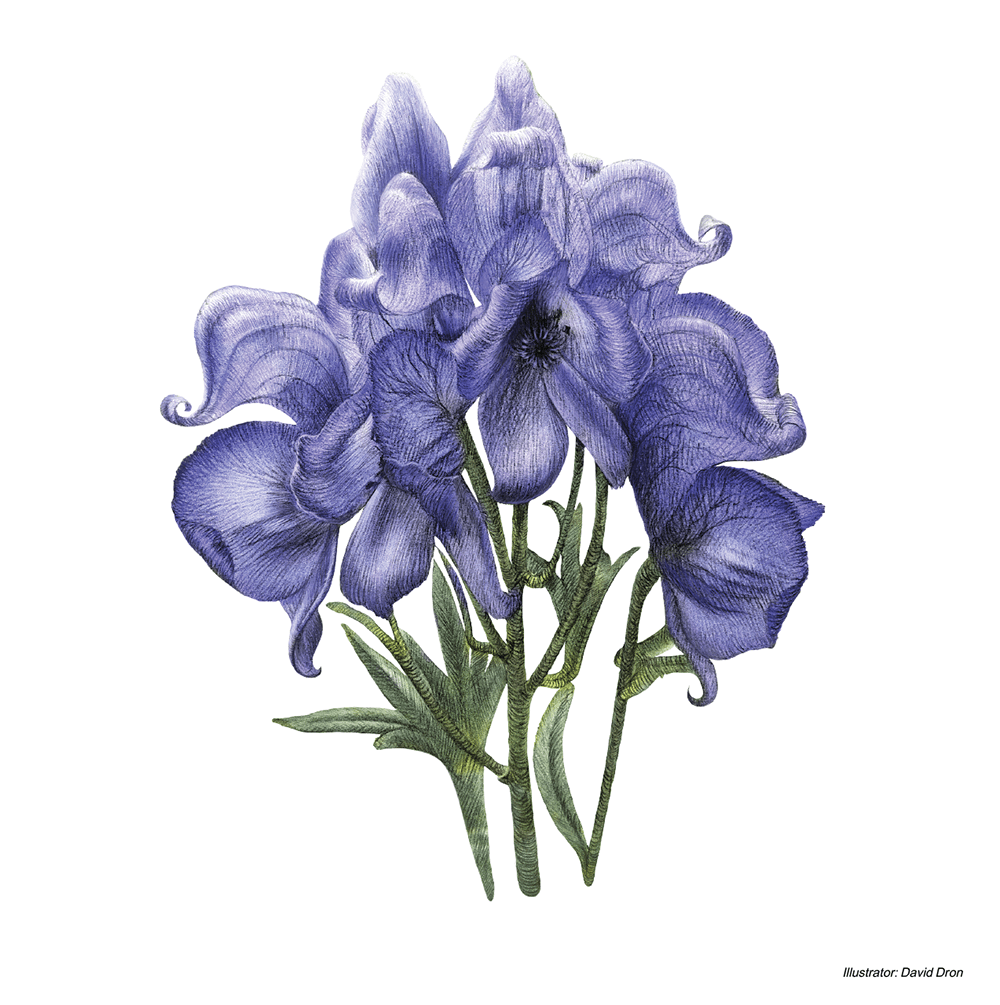
Monkshood

Species: Aconitum nasutum

Synonyms: Aconitum variegatum var. nasutum

Distribution: Georgia- Abkhazia: Tsebelda; Klichi Gorge; Avadkhara. Svaneti: Guli Glacier; Ushguli Glacier; Becho Crossing; Utviri Mountain; Shkhara Glacier; Latpari; Mestia; mountains between Mulakhsa and Shkhara. Racha-Lechkhumi: source of Rioni River; Pasi Mountain, Edena; Buba; Shakris-Tavi; Dolomisis-Tsveri; Shovi; Shoda-Kedela; Ghurshevi, Mamisoni; Chutkharo Mountain. Samegrelo: Lebarde; Guria: Somlia Mountain Range; Muchuta Mountain. Shida Kartli: between Kozanto and Ertso Lake, Ermani, Chaparukhi Gorge. Kartli: Borjomi, Bakuriani. Mtiuleti: Gergeti. Kakheti: Pokhalis Tavi, Gokhiani Mountain. Meskheti: Abastumani, Tsikhisjvari. Javakheti: Madatapa Mountain. Outside of Georgia- North Caucasus, South Caucasus: Azerbaijan, Armenia; Asia Minor

Habitat: Grows in montane forest and sub-alpine zones, in meadows and tall grass.

Conservation status (International):
NE (Not Evaluated)

Conservation status (national):
NE (Not Evaluated)

Remark: Endemic to the Caucasus. Decorative species. Described in 1803 by Marschall von Bieberstein from Beshtau. N. Busch indicated the following varieties from this group in the Georgian flora: A. nasutum var. gegas N. Busch, as well as A. tuscheticum N. Busch endemic to the Caucasus. Up to 300 species of the Aconitum genus occur in the temperate zone of the northern hemisphere. Seven species grow in Georgia.

Population size: Specific information about the population size in Georgia is not available.

*Levels of Threat by the International Union for the Conservation of Nature (IUCN): Least Concern (LC); Near Threatened (NT); Vulnerable (VU); Endangered (EN); Critically Endangered (CR); Regionally Extinct (RE); Extinct in the Wild (EW); Extinct (EX); Not Evaluated (NE); Data Deficient (DD)
detail right image