BIODIVERSITY IN THE SOUTH CAUCASUS

In collaboration with the National Geographic Magazine-Georgia and the Georgian National Museum supported by Silknet, the Map of Biodiversity in the South Caucasus and its website were recently created. In the first stage we have incorporated 120 illustrations and basic biodiversity information on species found in the South Caucasus (mostly Georgia) on the electronic version of the map. Each description, prepared by a field specialist, provides key information about each species. On the printed map there are 98 species represented, with their Latin, Georgian and English names and their conservation status according to IUCN.

The large scale (3m.X1.5m) printed version of the map is displayed at the Caucasus Biodiversity Exhibition of the S. Janashia Museum of Georgia.

In the future, both electronic and printed maps will be developed with additional species and habitats in neighboring countries.

Scientists from the Georgian National Museum have worked with species specialists from Ilia State University, with oversight by the National Geographic team of specialists who supervised the illustrators to create high quality images for each species represented on the maps.

Creation of the first ever illustrated Map of Biodiversity in the South Caucasus was entirely supported by the GIZ “Integrated Biodiversity Management, South Caucasus” Project.
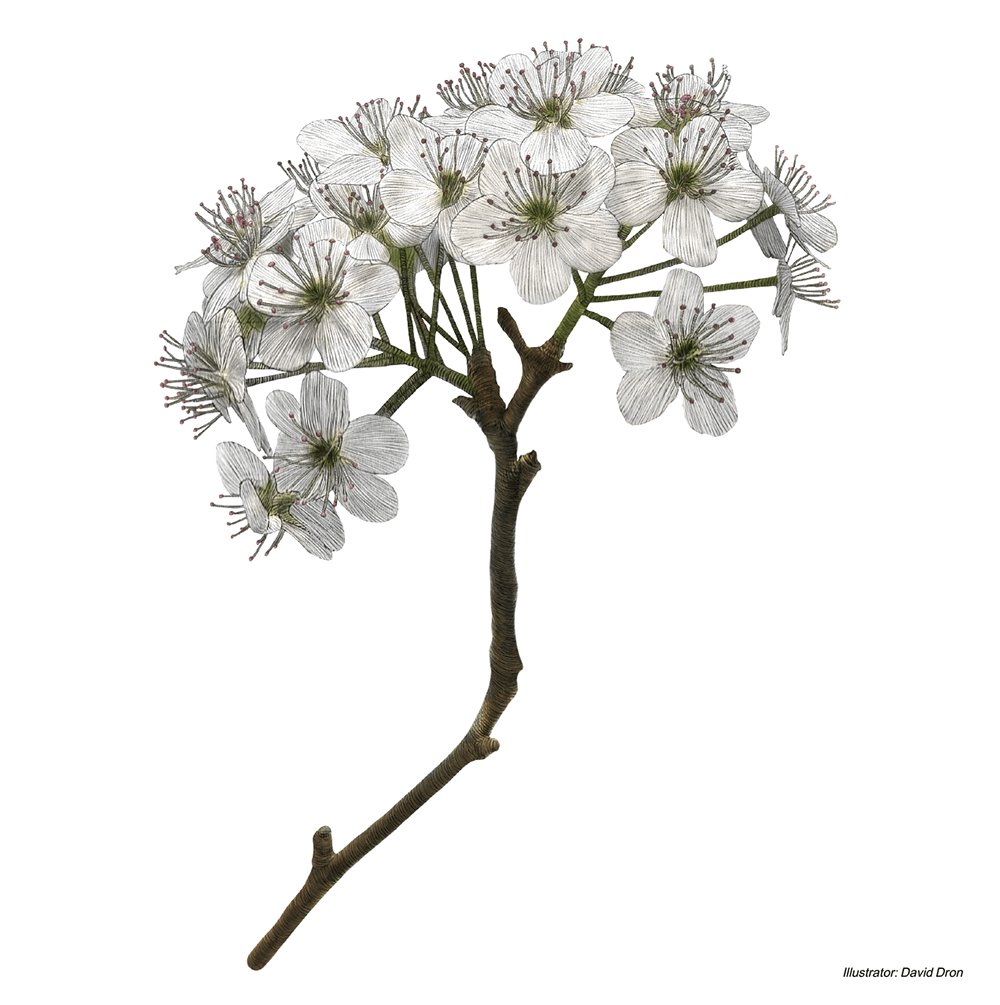
Sakchokia`s Pear

Species: Pyrus sachokiana

Distribution: Georgia- Kakheti: Kiziki; Shiraki, near Shavi Mta [Black Mountain]; Eldari. Meskheti: around Uraveli Village.

Habitat: Arid woodlands, foothill zones

Conservation Status (International):
EN (Endangered)

Conservation status (National):
EN (Endangered)

Remark: Rare, narrow-range species endemic to eastern Georgia. Important for studying history of flora. Used as rootstock. The range of the species is declining due to felling and intensive grazing. The species is not protected in its range; only two groves remain. There are up to 60 species of the genus Pyrus that occur in Eurasia. In Georgia, 11 species of this genus grow of which four are endemic to Georgia and three to the Caucasus.  “Panta “ or wild pear, like “mazhalo”  or wild apple, is an important wild fruit, used for food, to make dried pears and vodka. The bark is used to make chestnut-brown dye. It has good timber and is a honey plant.

Population size: Information about the population size of this taxon in Georgia is not available.

*Levels of Threat by the International Union for the Conservation of Nature (IUCN): Least Concern (LC); Near Threatened (NT); Vulnerable (VU); Endangered (EN); Critically Endangered (CR); Regionally Extinct (RE); Extinct in the Wild (EW); Extinct (EX); Not Evaluated (NE); Data Deficient (DD)
detail right image